
Ground Source Heat Pumps – The Basics
The ambient heat in the ground can be captured and used to heat your home. The sun heats the earth and then pipes buried in the garden can be used to extract the heat from this ground. Ground source heat pumps concentrate this heat for use in radiators, under-floor heating systems and hot water systems. Even at depths of only 1 meter, the ground stays at a fairly constant temperature of approximately 12°C all year long, so a ground source heat pump can be used even in colder months. The more modern systems compensate for the weather outside, providing more heat inside when the outside temperature falls.
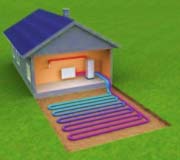
Ground source heat pump diagram showing ground pipework
You can save up to an estimated £1,000 in energy bills per year with a ground source heat pump if you are currently using electric heating.
Calculate how much money you could save!
How Ground Source Heat Pumps Work
You will need enough space in your garden to bury a loop of piping called a ‘ground loop’ which extracts the heat from the ground, though the ground loop can be buried in vertical boreholes if space is limited.
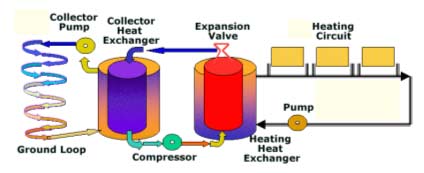
Ground source heat pump system showing all components of the system
- A mixture of water and antifreeze flows through the ground loop – which is buried in the ground. This fluid absorbs the heat from the earth
- The heated ground loop fluid is then pumped into a heat exchanger, transferring the heat to a refrigerant
- The refrigerant is compressed in a compressor, which concentrates the heat to a higher temperature. The heat is now hot enough to heat water for either heating or hot water.
- The ground loop fluid is cooled again by this point and flows back into the ground where it extracts more heat, repeating the process
- The length of the ground loop you will need depends on how large your home is and your demand for heating and hot water. The longer the loop is the more heat it can extract from the ground, and the more space it takes up in your garden
There are other types of heat pump and they work on a very similar principle, instead extracting heat from different sources:
- Air Source heat pumps: They remove heat from external air and are an attractive option as they are economic and simple to install, especially if you live in a city with little outside space.
- Water Source heat pumps: This is a similar system to a ground source pump except that the ground loop is placed in a local water source, such as a river or lake.
- MVHR (Mechanical Ventilation and Heat Recovery): This is essentially exhaust-air-source; this system reclaims the heat from warm air leaving your home via vents. This system is most efficient in more air-tight, well draught-proofed homes.
Installing Ground Source Heat Pumps
In England, Scotland and Wales ground source heat pumps do not normally require planning permission, however, you should check with your local authority to confirm that permission is not needed for your project. Usual locations for the pump include your utility room, basement or even out in the garage.
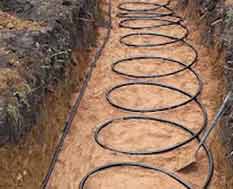
Ground source heating pipes layed in trench
Normally the loop is laid coiled in trenches about two metres deep, and a typical home would need around 600ft. A typical ground source installation for a 2 bed detached house would need (at least) two trenches about 12 inches wide and about 45m long. The trenches also need to be about 15 feet (5m) apart. The trenches will ideally be level to avoid making the pump work too hard and the wetter the ground the better as more heat is conducted. If you have limited space in your garden the loop can be buried vertically in the ground, usually to a depth of up to 10 metres for a typical home.
See if a heat pump is suitable for your home
Ground Source Heat Pump Installation Checklist
You will need to think about the following:
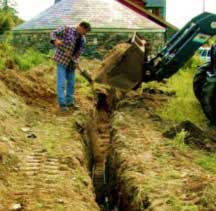
Trench containing ground source heating pipes being filled in
- Installing a ground loop: You will need plenty of level outside space to bury the ground loop, however if you don’t have much outside space it is possible to dig a borehole. This means that digging machinery must be able to access the space where the bore will go
- Home insulation: For the system to be efficient it’s important that your home is draught proofed and insulated well. Ground source heat pumps produce a heat at a lower temperature than conventional boilers, and so draughts make them much less efficient
- Existing fuel source: If your current heating system is electric, solid fuel or oil based, a ground source heat pump should deliver substantial energy savings. Homes using a gas system will see a smaller saving
- Heating system: Larger radiators, under-floor heating or low temperature fan convectors (warm air heating) are more efficient than conventional radiator-based systems when used with the heat pump because of the lower water temperatures produced by the heat pump system.
- Do you have any other building projects in mind? You may be able to substantially reduce the cost of the pump installation by combining it with any other building work you have planned.
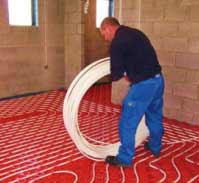
Underfloor heating system pipework being layed
The efficiency of a heat pump is measured by it’s Coefficient of Performance (CoP); this is a measure of a heat pump’s ratio of heat output to electricity input, so the larger the figure, the more efficient the pump. Heat pumps can produce up to 4 kilowatts of heat energy for each kilowatt of electricity they use to generate this energy.
An alternative measure known as the System Efficiency Ratio (SER) has been devised by the Energy Saving Trust (EST). This is the ratio of how many units of electricity the whole heating system uses to run compared to the number of units of heat the pump produces. Both the SER and CoP range from around 1 to around 4. A recent study into heat pump performance has found that the mid-range SER for ground source heat pumps was around 2.3-2.5, with the most efficient units reaching 3.3.
Ground Source Heat Pump Installation time
The installation time for a ground source heat pump system does vary and depends on the size of the system. You can potentially save a significant amount of money on your installation bill by combining the installation with other building work and because of this the installation time will depend on this also.
Ground Source Heat Pump Installers
Only MCS accredited installers are able to validate installations that qualify for the government’s Renewable Heat Incentive and Renewable Heat Premium Payment schemes.
Ground Source Heat Pump Costs
After the one-off installation cost of £6,000- £18,000, how much the system costs to run depends on a number of considerations – including how large and how well insulated your home is. Savings of more than £610 on your energy bills can be achieved annually if you are converting from an oil or electric heating system.
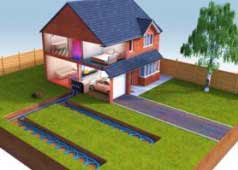
House showing ground source heating system pipework layed in garden area and how it’s connected to boiler
You can also get your ground source heat pump installation either partially or fully funded by any of the overnment schemes that may be running.
Heat pumps operate differently to oil and gas boilers in that they produce heat at lower temperatures over much longer periods. Because of this, during winter months it is best to leave them constantly switched on to heat your home efficiently. This might seem counter-intuitive at first but they do require a different mindset to operate efficiently.
Find an accredited local installer now
The benefits of Ground Source Heat Pumps
You could make a saving of over £610 per year on your heating bills, although the amount does depend on your existing heating system. You can also get a one off payment of £1,250 through the Renewable Heat Premium Payment scheme and quarterly payments for the heat you generate if the pump is fitted by an MCS accredited installer. There are some additional benefits:
- Minimise your carbon emissions: Heat pump systems reduce the amount of fuel you need to burn to heat your house, reducing your home’s carbon emissions
- No fuel deliveries: There is no need to have fuel delivered to your home as the heat pump only needs electricity to run
- No boiler required: In a heat pump system there is no need to top up the hot water it produces with a boiler
- Low maintenance costs: Heat pumps need little maintenance so are known as a ‘fit and forget’ technology
Ground Source Heat Pumps – Maximising Your Savings
The savings you make by installing a heat pump will depend on several factors:
- How heat is distributed: Under floor heating rather than radiators are more effective because the water is not so hot and needs a larger surface area to transfer the heat to the room
- The current heating system: The less efficient your current heating system is, the more likely that you will see reduced running costs with a heat pump
- Whether you use the pump to heat hot water: This can lower the pump’s efficiency. A solar thermal system could be installed to top up hot water in hotter months
- How the system is used: Heat pump are more effective if the heating is on for a longer period each day however the thermostat temperature can be reduced without discomfort as you will be experiencing much more constant temperature

 DIY Doctor Ltd,
  0845 6342 179


