
Where the base of a wall resides below ground level is can become subject to many damp issues including the salts that are present in ground water and also in colder conditions, freeze-thaw action where water and moisture freezes in tiny cracks and pits in the walls surface and forces it apart over time.
In this how-to guide you will learn all about diagnosing and fixing damp issues below a damp proof course.
Testing for Damp
One of the quickest and easiest ways to test for damp on a DIY basis is to purchase a basic damp meter (as seen in the image below).
To use it, simply stick the 2 metal prongs on the base into the surface you suspect of being damp and the meter will indicate the moisture levels on the read out on the front of the tool.
A reasonable quality damp meter can be purchased for little money these days and they’re handy to have laying about so they’re well worth purchasing.
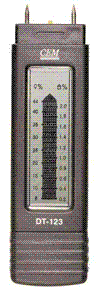
Damp Detection Meter
Damp Below Damp Proof Course Level
When checking for damp below your damp proof course, think about the following quick summary checklist:
- Tip 1 – if a concrete floor is damp all over it is hard to isolate the moisture source. As it dries out the damp retreats slowly back to the points of ingress, so if you are not able to see any isolated damp areas either ventilate and heat or shut all the doors and windows and use a dehumidifier
- Tip 2 – always check the relative level of your floor to the outside ground level and damp proof course. If the floor is below the damp proof course you will need to tank the overlap and seal the wall to floor joint, to prevent laterally penetrating dampness
Diagnosing Causes for Damp Below a DPC and How to Fix Them
Isolated Damp Spots on Concrete Floor
The Symptom
Where isolated damp spots on a concrete floor that are not touching the edges are present, this is normally due to small holes in the plastic DPC membrane (Visqueen 1200 gauge is normally used) that’s caused by the fact it’s been laid onto sharp hard core without a sufficient sand cover.
When this happens and there isn’t a decent layer of sand to protect it, the sharp hard core base punctures the DPC membrane and allows water and moisture to penetrate, causing damp.
A water leak will also add to this problem, so to rule this out always use a leak testing check list as follows:
- Contact your water board and ask them to run a test on your water main pip. Also ask them to check any neighbours supplies or any above you if you live on a hill or slope
- If you have visible water present ask your water board to test it and analyse where it comes from
- Test your own drain by blocking the drain flow in the manhole, filling a sink of water, leaving it over night and seeing if it goes down
- Add drain testing dye to your drain and then add water. Wait until nightfall and then see if you can see any trace water. It’s luminescent so will glow up
In any of the scenarios above, leaking water can easily find its way into a property and cause damp and mould.
The Remedy
In terms of a fix for damp and mould spots on a floor there are a few options.
The first is to dig up the entire floor and re-lay a new DPC membrane over the floor area and then lay a brand new concrete floor slab, screed etc. down. This is effectively laying a new floor.
This route obviously involves quite a lot of hassle and expense but one of the advantages is that if the existing floor slab isn’t as well insulated as it could be, during digging up the old floor you can then add insulation to the new floor.
As said, this is obviously a huge amount of work, hassle and expense, but in some cases it’s the only option.
The second option is much more straight forward and often the go-to fix for damp floors. Firstly the entire floor area is cleaned down and all dust and debris is removed and then you can either coat the floor area with an epoxy damp proof membrane.
There are many options available on the market today, but always opt for a good quality coating such as those from Permaguard, Watco etc.
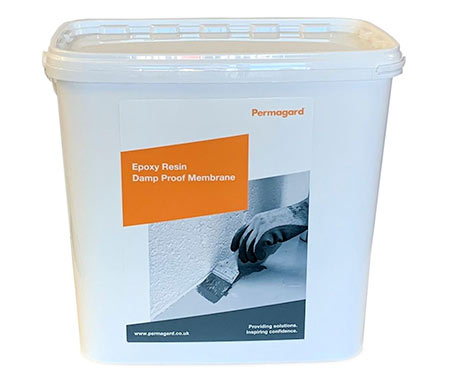
Permaguard damp proof membrane for floors
One other solution that’s particularly effective if you are suffering from salts is to install an air gap membrane. For more information on this see our installing a damp proof membrane project here.
Although the project looks at lining damp walls, laying the membrane on a floor uses pretty much the same principles.
Membrane of this type laid on the floor can be screeded (minimum 2 inches, 50mm) or a chipboard floor can be directly laid on top to create a ‘floating’ floor. At least 18mm board should be used.
Tanking Slurry Powder – brush on to waterproof walls and floors
Wall and floor Membranes – cavity drain ‘tanking’ for floors and walls
Damp Areas Coming From Edges of a Concrete Floor
The Symptom
If you have damp areas on a concrete floor that are touching and emerging from the edges of the floor then this is probably due to a lack of joint material where the plastic DPC membrane butts up to the wall edge.
Under normal circumstances, the DPC membrane under the floor will be tucked into the first few courses of bricks making it impossible for any water or moisture to travel up from ground level into the interior of a property.
If this isn’t done correctly and the joint between the walls of a given room or property and the floor slab isn’t sealed correctly into the first few courses of bricks then this can lead to moisture accessing the floor and spreading into the room area.
Additionally, a water leak will add to the problem, so always use a leak testing check list (see the one mentioned above).
The Remedy
To resolve issues such as this the best method is to seal the joint between the wall and the floor so that moisture can’t get up and into the floor slab and cause any damp issues.
To do this, using a hammer and bolster, clean out the floor to wall joint until you can find the plastic membrane all the way around the floor. Take care not to damage the membrane as tis could cause additional issues.
Chisel out a ″U″ shaped channel in the floor at least 25mm x 25mm (1 inch x 1 inch) all the way around the edge of the room.
Once done, fully clean the channel out using a vacuum. Ensure that any and all dust and debris had been removed.
With your channel created, coat all the faces of the channel with 2 coats of SBR (the builders version of PVA glue) and then mix up 4:1 sand and cement mix that uses a 50/50 mix of water and SBR and then fill the channel with the mix.
Once your filled channel has cured then this will create a water proof barrier around the edge of the room or property preventing any water and moisture from finding its way up into any rooms.
Fluffy White Salts and Blowing Plaster
The Symptom
If you have noticed white, fluffy salts forming on your walls surfaces and in most cases will also be causing the plaster to blow off the wall and crumble then the chances are you have efflorescence (learn more about efflorescence in our project here).
One of the number one causes of efflorescence is water and moisture and with this in mind the chances are that you have a water source which needs to be found and eliminated e.g. a leak.
Again as before, use the water leaks check list mentioned above to help you trace the source and once you’ve found it, it needs to be fixed.
Remedy
When it comes to a fix for efflorescence, in most cases it will have damaged any plaster present. How bad that damage is will depend on how long it’s been left there for.
A great product for treating the effects of efflorescence on plaster is Salt Neutraliser as it will neutralise the salts but there are limits to this.
If the salts are too embedded in the plaster and it’s flaking or spongy and there is too much damage then the only answer is hack it all off and replaster.
However when it comes to replastering you will have to ensure once the old plaster has been removed, the surface beneath should be treated with a salt neutraliser and the new plaster that’s put on should not be a modern light-weight gypsum plaster as any salts will damage it easily.
If efflorescence issues are too bad then once you’ve taken the surface back down to the bare wall a membrane should be installed and then plaster can be laid on to that. The membrane will then protect the plaster from any salts remaining in the brick or block work.
Full information on treating salts and efflorescence can be found in our efflorescence project here.
Low Level Damp Patches Down to Skirting
The Symptom
If you have damp patches at low level, right down to the skirting board or your skirting boards are rotten you most probably have hygroscopic salts.
Hygroscopic salts are a type of salt that attracts moisture and when it does a damp patch forms over the area the salts are present.
Moisture exists in the air all around us and sometimes more moisture is present in the air than other times and it’s on these heavy and humid occasions that hygroscopic salts will suck the moisture out the air and trap it on walls and other surfaces.
With this in mind damp issues caused by this phenomenon can come and go, typically when it’s dry and hot and then appear when it’s humid.

Hygrometer for detecting hygroscopic salts
The Remedy
In the majority of cases, the cause of hygroscopic salts is down to the fact your damp proof course may be bridged by high outside ground, plaster on the inside or debris in the cavity (cavity walls only).
To fix this issues, clean out the floor to wall joint until you can find the plastic membrane all the way around the floor, and create a ″U″ shaped channel in the floor at least 25mm x 25mm (1 inch x 1 inch).
Once created, fully clean the channel of all dust and debris.
Next, rectify any defects and tank the wall area below the correct damp proof course level (6 inches or 150mm above outside ground level) into the floor to wall notch you have just channeled out.
Finally, fill the channel with sand and cement (4:1 sand to cement) incorporating SBR liquid at a ratio of 50/50 (water to SBR).
Just before you fill the trench, use the SBR as a liquid primer to cover all the faces of the prepared ‘slot’.
As it’s also likely that the DPC (damp proof course) is damaged you will need to create a new one. Using an injectable cream DPC, inject your new DPC into your walls at the correct level to form a new Damp Proof Course.
Finally as it’s likely that ant plaster present on the wall has suffered damage it will need to be removed and replaced with new, so the old plaster needs hacking off around 100mm above any damage and then new plaster adding once the surface below has fully dried out.
Damp Patches Around Chimney Breast Base
The Symptom
If you have found that you have damp patches on or around the base of any chimney breasts, sometimes appearing as yellow or brown stains in wallpaper or paint then the chances are you have hygroscopic chimney salts.
These differ slightly from the other hygroscopic salts mentioned above in that although they do attract moisture from the air in the same way, they can also pull the buildup on the inside of the chimney through which may include tars and other chemicals from burning wood or coal.
The Remedy
The salts in hygroscopic chimney salts are very difficult to hold back in the wall, even with the replastering to our carried out to perfection and any and all surfaces treating with salt neutraliser.
The only solution that, in most cases, prevents these salts from penetrating walls and plaster is to line them using a mesh damp proof membrane so that you can then plaster over the top without the risk of the salts seeping back through.
When you are faced with damp issues below your damp proof course this can seem like a huge hassle that could potentially cost 000’s to resolve, however with time and the right products, it’s generally something that can be overcome in a straight forward manner.

 DIY Doctor Ltd,
  0845 6342 179


