
Domestic Wind Turbines – The Basics
Households can now make use of wind power technology by installing micro turbines, also known as or small-wind or ‘microwind’ turbines. When the wind is strong enough it turns the blades of the turbine, generating electricity. The U.K. climate is ideal for wind harnessing technologies as 40% of the wind in Europe is experienced here, and in the right area you should be able to see substantial savings on your electricity bills.
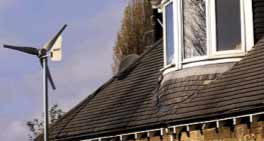
Pole mounted domestic wind turbine
There are two types of microwind turbine:
- Building mounted: These systems are installed on your roof, and have a fairly small capacity, averaging 1-2kW
- Pole mounted: These installations are freestanding and have a larger capacity of around 5kW-6kW
The Energy Saving Trust has calculated that in an ideal location a roof mounted micro-turbine system could reduce your electricity bills by around £350 a year. Your system could also be eligible to receive payments for the electricity you generate through the government’s Feed-In Tariff (FIT) scheme. Here’s how the scheme works:
- You are paid a ‘Generation Tariff’ for each unit of electricity you generate, regardless of whether you use it or not, at a tariff rate that is fixed when you make an application for the scheme. The scheme then pays you starting from when you apply to the scheme, for 20 years. A pole mounted installation in an ideal location could receive £2,700 a year at current tariff values.
- You are also paid an ‘Export Tariff’ for any generated electricity that you don’t use. The same pole mounted installation could receive £160 a year in export payments at current tariff values.
- The electricity that you generate is free for you to use. If you use more electricity than your system is generating at any point you will be taking it automatically from the grid as you do now, which you will pay for. Overall, however, you will still save money on your electricity bill.
- You can get a loan to cover the cost of installing your system by instead signing up to the Green Deal scheme. The loan is recovered via your energy bill, using the money you have saved on your energy bill by using the system. This means that the installation should not cost you any additional money.
How Domestic Wind Turbines Work
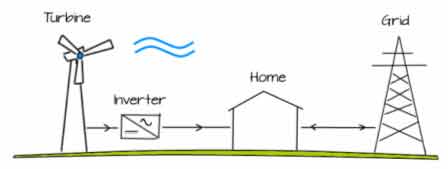
How a domestic wind turbine feeds electricity to your home and to the national grid
- When the wind turns a wind turbine’s blades this movement drives the rotating shaft the blades are attached to. This shaft sits inside a generator. Inside the generator the shaft is surrounded by a magnetic field, so that when the shaft rotates it generates an electric current. In smaller turbines the blades can be attached directly to a generator with a magnetic field.
- The electricity the turbine produces is DC electricity. This DC electricity passes through a device called an inverter, which connects the turbine and your home’s electrical system. It converts the DC electricity to AC electricity which can be used in your home.
- The electricity the wind turbine generates can be fed directly into your home or stored in batteries. The turbines can be connected to the national grid so that you can export any surplus electricity and receive FIT payments for your electricity, or you can keep your turbine off the grid and store your surplus using batteries, though this arrangement won’t qualify for FIT payments.
- If your turbine is connected to the grid, any surplus electricity is automatically exported to the grid, and if you use electricity from the grid this is also supplied to your system automatically.
The providers of the FIT scheme do not currently measure how many units of electricity you export, but for microwind turbine systems it is assumed to be 75% of the electricity you generate. The capacity of a microwind turbine system to generate electricity varies according to the individual system, and can be described in kilowatts (kW). This value can range from approximately 0 to 15. The average capacity of a house mounted system is 1-2kW and the average capacity of a pole mounted system is 5-6kW.
Whilst this measure is valuable, it does not fully describe the capacity of a turbine as the wind speeds at which this capacity is reached differ from turbine to turbine. This means that the Small Wind Turbine Performance and Safety Standard is also used. Contained within this standard is the BWEA Reference Annual Energy. This is the energy in kWh that the turbine will produce annually at a consistent wind speed of 5m/s at a set turbine height. A second value, the BWEA Reference Sound Levels give the noise level of the turbine from 25 and 60m away rounded up to the nearest decibel (dB).
Installing Microwind Turbines
When considering a microwind turbine installation it is essential that you accurately measure the wind speed of your specific location. The average annual wind speed required to make wind turbines worth the investment is a minimum of 5 metres per second (11 mph), which is not usually achieved in urban or suburban areas. This is because the wind speed in urbanised areas is usually reduced by by closely arranged buildings and trees. Nearby hills can also affect wind speed, as does whether you live in a valley or not.
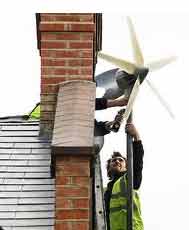
Building mounted domestic wind turbine
It is strongly recommended that before you commission a microwind installation that you accurately measure your local wind speed by buying and fitting an anemometer (wind measuring instrument). You should leave this device to carry out measurements for at least three months but ideally you should leave it for a year to get a comprehensive overview of the wind levels your property is exposed to.
Domestic Wind Turbine Installation Checklist
There are a few important things to consider:
- Building mounted or pole mounted: Building mounted systems have a lower capacity than pole mounted systems, meaning that they will generate less electricity and are cheaper to install
- Whether you want to connect to the grid: Currently you will need to connect to the grid to receive FIT payments. Contact your local DNO (District Network Operator) to arrange connecting your turbine to the grid
- Whether your local area is prone to power cuts: When the power in an area fails all inverters connected to the grid are switched off, meaning that your system will stop working. You can install batteries with your turbine to provide a back-up electricity store – ask your installer for more information
- Roof integrity: If you are intending to install a building mounted turbine it’s wise to consult your installer on whether your house is durable enough to support the turbine – they can be heavy and vibrate when in use
- Planning permission: There are currently permitted development rights granted for domestic wind turbine systems in England, which should mean that you won’t need planning permission for your installation. However, the criteria for this are complex and there are varying needs for planning permission across the rest of the U.K. It is therefore wise to check the planning permissions for your installation with your local authority well in advance. You will have to supply a number of documents as well as paying an application fee of £150. It is a good idea to meet with a local planning officer before submitting your application so you know exactly what is required, as is consulting with any third parties such as neighbours who may be affected by your installation. Some installers will provide information and support with filling out planning applications
- Environmental permissions: If your planned turbine is over 15m tall or you are planning to install two turbines you may be required to commission a bat or bird survey of the area
- Your energy supplier: The larger energy companies have a legal obligation to be registered FIT suppliers but for smaller companies this is optional. Check with your energy supplier to see what they provide regarding FIT
- Are you carrying out other building projects? You might be able to reduce the size of your installation bill by carrying out the work at the same time as any other building or landscaping work you are planning
Installation Time
The time your system will take to install will vary with your specific circumstances, particularly if you decide to carry out the installation at the same time as other building work.
Domestic Wind Turbine Installers
If you intend to apply to the FIT payments scheme you will need to ensure that your installation is carried out by an MCS accredited installer using parts that meet MCS standards. When your installer signs off your installation as being MCS compliant they will give you an MCS certificate that you will need when applying for the scheme. If you are financing your installation through the Green Deal you will need to instead use an authorised Green Deal installer.
Domestic Wind Turbine Costs
A standard 1kW building mounted turbine installation costs around £2000, with a 2.5kW turbine costing around £15,000 and a 6kW around £23,000 including installation costs.
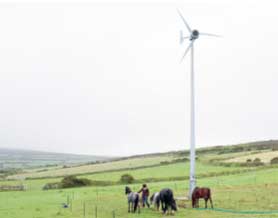
Pole mounted domestic wind turbine
Typically larger systems cost more to install but can generate more electricity, delivering you bigger energy savings and larger tariff payments. An average system working in a 5 m/s wind speed location can save you around £350 on your electricity bill and pay you £160 in Export Tariff payments and £2,700 in Generation Tariff payments every year. You will be paid these tariffs from the date you register for FIT payments for 20 years.
The system will run for at least 20 years, and as the tariff value is set at the start of payments and index linked it is likely that the system will pay for itself in 7 years or less. After this point you will be receiving savings on your electricity bills and payments for around 13 years. For more information on the FIT scheme you can visit our Feed-In Tariff (FIT) page.
In terms of maintenance, your installer will be able to give you specific guidance on any maintenance checks that need to be carried out. Usually it is recommended that you get your system professionally checked yearly at a cost of £100-£200. The turbine system comes with a lifetime warranty but the inverter may need replacing during that time at a cost of £1,000-£2,000 for larger systems. Any batteries used with the system will usually have to be replaced every 6-10 years.
The Benefits of Domestic Wind Turbines
An average household installing a well-sited domestic wind turbine system could benefit by over £3,200 a year. This includes the money you could save on your electricity bill as well as the Generation Tariff and Export Tariff payments you could receive from the FIT scheme. Our Feed-In Tariff scheme page contains more information on this new initiative. Domestic wind turbines deliver additional benefits:
- Reduce your carbon footprint: A 6kW pole-mounted wind turbine system can save around 5.2 tonnes of CO2 a year.
- Pays for itself quickly: Larger systems have a payback time of around 7 years at current tariff rates, meaning that your system’s payback time could be similar or less.

 DIY Doctor Ltd,
  0845 6342 179


