
There are two types of home drainage system in use in pretty much all homes:
- Foul drainage removes the waste from the toilet, bidet, bath, basins, sinks, washing machines, dishwashers and showers.
- Surface water drainage deals with rainfall as it collects around your property.
In older houses the surface water is often fed into the foul water system. Foul water is never allowed to be fed into a surface water system. All underground pipes must be brown in colour to distinguish them from any other underground service pipes.
Foul Drainage Systems
When the toilet is flushed, or water released from basins etc, the first thing that happens is that it passes through a “trap” usually shaped like a P or an S on their sides. This trap is designed to hold water in the bend of the P or S.
Under some basins and showers special traps are placed which do not have these shapes but their internal workings are designed to fulfil the same objective. This objective is to stop foul gasses from the drain runs and manholes, entering the room. The water sitting in the U of the trap stops this.
As you can see from the diagram, when the loo is flushed, water and waste enters the bowl and is forced round the bend into the pipe which carries it through the wall of the property at some point, to the main sewer. This pipe is called a soil and vent pipe.
The “vent” part of the name indicates that the pipe serves two purposes. It also carries the foul gasses up to and beyond the roof. All traps work in this way.
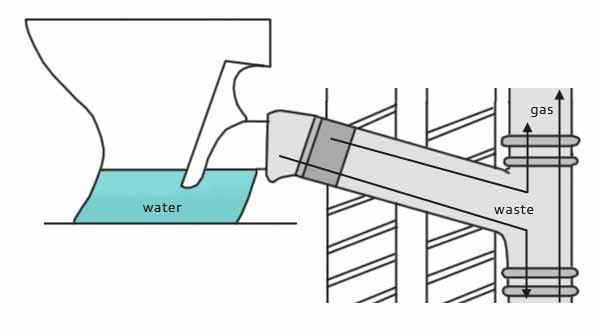
Toilet Pipework and system
Once the waste has left the property it is directed to an inspection chamber where more pipes may join. These pipes can come from other outlets in your home, or from other houses in your area.
Inspection chambers are placed wherever two (or more) pipes join, or a single pipe changes direction. This is because these scenarios are the most likely to cause a blockage. An access chamber or manhole will allow access to a blockage. See our project on Unblocking Drains.

Waste pipe joining external pipe
The soil and vent pipe (SVP) may also “pick up” pipes from basins, showers etc on its way to the manhole. These pipes are connected to the SVP by drilling a hole in the SVP and strapping, or bolting on a fitting called a strap on boss. The boss allows the pipe to be inserted into a plastic collar, inside which is a rubber seal.
A strap on boss is easily fixed and a very useful fitting for the DIY enthusiast involved in fitting a new bathroom or shower.
When fitting a new toilet the chances of the new outlet pipe matching up with the position of the SVP connection are small. DIY stores, plumbers’ merchants and builders’ merchants sell a variety of adapters specifically for this problem. These adapters are called pan connectors.
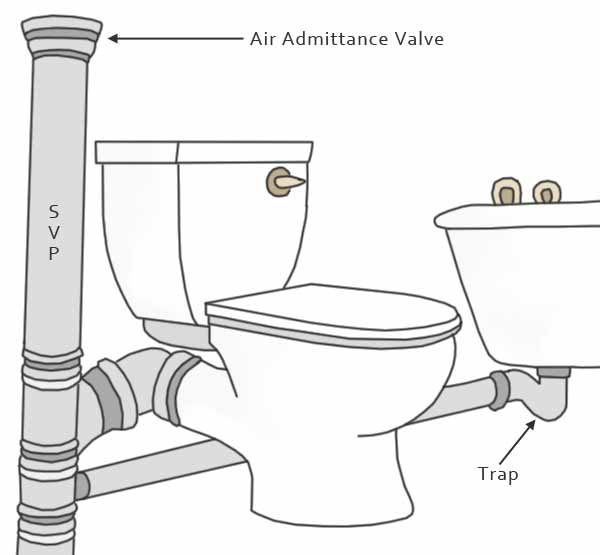
Internal Soil Vent Pipe system
The SVP, or some of it, can sometimes be indoors and it is usually boxed in. In certain circumstances (you should check this with the Building Control officer of your local council) it is permissible to place an Air Admittance Valve on top of an internal SVP. This saves the expense of taking the pipe up to roof level to vent it. An Air Admittance Valve allows air from the room to be “sucked” into the pipe but does not allow the foul air to escape.
There are restrictions on the use of these valves so please check.
If you are allowed to use one, the valve must be positioned at a height which is above the highest flood level of the room. In most cases this is the height of the basin rim.
Surface Water Drainage and Gutters
Water lands on your roof and runs down into your gutters. From your gutters it is directed to the surface water drainage pipes in your garden. From these, via manholes and access chambers, it is sent to the main “storm” drain network of the town.
Some properties do not have a surface water drainage system. The rain water in these cases is taken to a large drainage pit in the garden called a soakaway.
Surface water drainage systems operate in much the same way as the foul drainage, with manholes at junctions and changes of direction. The guttering system around your house is much more likely to concern you, and we have listed the names of the various parts of a gutter below.
Water will always find the lowest point to drain to, so the outlet pipe of a gutter must be the lowest point. The most common fault with DIY guttering is that not enough gutter brackets are used to keep the slope or “fall” of the gutter constant down to the outlet pipe.
The shortage of brackets causes the gutter to bow in between them. The bow collects water and overflows. This overflow looks like a leak and many hours are wasted repairing joints which are perfectly sound!
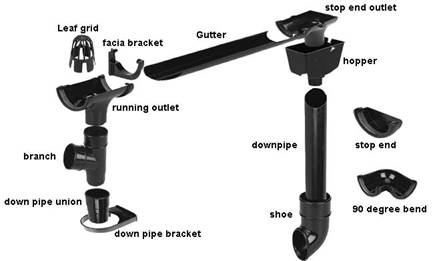
Individual elements that make up a guttering system
The Gutters should be cleaned regularly, especially if you have trees near you. Clogged gutters can lead to wet walls, which in turn can lead to damp and mould. A lead grid in the gutter and at the top of the gutter downpipe will help keep leaves in the gutter where they are easier to clean out, rather than let them block the downpipes or gulleys.
The surface water not collected by the gutters should drain away harmlessly on your land. Spacing between gutter brackets should be no more than 1m.

 DIY Doctor Ltd,
  0845 6342 179


