
Air Source Heat Pumps: The Basics
Air Source heat pumps extract heat from the air outside your home and then concentrate it to a higher temperature. The pump then uses this heat to heat your home or hot water. These systems are normally used with under-floor heating, low temperature radiators or warm air convectors, substantially reducing your energy bills. Air Source heat pumps are easier to install than Ground Source heat pumps.
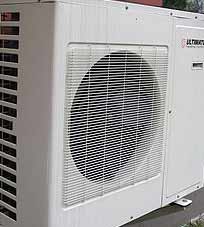
Air Source Heat Pump unit
Heat can be taken from external air even when outside temperatures are as low as minus 15°C, but heat pumps do have a higher level of efficiency at slightly warmer temperatures than this.
They use some electricity to circulate the heat that they extract from the air outside around your home, but they will capture more energy than they use, and are more efficient than many other heating systems. They operate most effectively in more airtight and well insulated homes.
The savings that you can make on your energy bill with this technology depend on which type of fuel you are replacing, however the Energy Saving Trust trials suggest that homes using solid fuel or oil could make a saving of around £300. A 3 bedroom semi using electricity for heating and hot water could save as much as £610.
How Air Source Heat Pumps Work
They are generally the size of a small air conditioning unit and are mounted on an exterior wall, ideally with a good air flow around it. Unlike a ground source heat pump you do not need any outside space to bury piping.
- The air handling unit is the part of the system that is fitted onto the outside of your house. It is a box containing a large fan that pulls the external air into the unit.
- In the same way as a ground source heat pump works, the air source heat pump contains a fluid which absorbs heat from the air and is then pumped through a heat exchanger
- Heat is extracted by the heat exchanger and then pumped through a heat pump compressor, to concentrate it into a higher temperature. In doing this it takes the low ambient heat from outside air and concentrates it until it is hot enough for heating water for use in a hot water heating system
Heat pumps can only deliver heat of a temperature up to about 60°C efficiently, which means that they are most effective if they are left on all the time during winter months. They are most effective for heating when used with lower temperature radiators or under floor heating as they do not produce water as hot as gas fuelled systems and need a larger surface area to transfer the heat into the room.
Air source heat pump systems fall into two main categories, based on how they deliver the heat into your house:
- An air-to-water system – (Described above) the heat from the air outside is used to heat water which is distributed via your water filled central heating system. For maximum efficiency they usually use large radiators and under-floor heating as the heat is delivered at a lower temperature. The heat can also be used to heat your hot water too
- An air-to-air system – This works in a very similar way, except the heat captured from the outside air is used to create warm air which is then used to heat your home, circulated by fans
Another type of heat pump that works on the same principle is the MVHR (Mechanical Ventilation and Heat Recovery) system, an exhaust-air-source heat exchanger which reclaims the heat from the air leaving from your home via vents. This is really only effective in modern air-tight homes.
Installing Air Source Heat Pumps
It is not necessary to bury piping in the ground outside as for the Ground Source heat pump, but you will need space on a wall outside to mount the air handling unit. They do make some noise, so take this into account when deciding where to place your unit. You can get the decibel rating of the unit checked and models with a cover are generally quieter.
Installing an air source heat pump is generally easier than other types of heat pump; however it is a good idea to think about how it will work with your current heat emitting system, particularly if you have water filled heating system.
Air Source Heat Pump Installation Checklist
You will need to think about the following:
- Your house’s insulation and radiators: Heat pumps are not suitable for use in houses where the levels of insulation are not known and where the age and type of the heating distribution system (radiators and pipes) is unknown. Air source heat pumps produce heat at a temperature lower than conventional systems and therefore work most efficiently when your home is insulated well and fairly airtight
- Locating your Air Source heat pump: You will need an outside wall to attach the unit to, in a position with a good airflow and which is ideally sunny. The unit can be wall mounted or placed on the ground
- Replacement System: If your current heating system uses oil or solid fuel an air source heat pump will deliver a significant energy saving, but they are not substantially more energy efficient than a gas system. This is why homes on the gas network are not currently eligible for a Renewable Heat Premium Payment; however homes on the gas network might be eligible for regular payments for heat generation through the Renewable Heat Incentive scheme which will be introduced in Summer 2013. If you are using a gas system you may also qualify for a loan through the Green Deal
- Which heating system? As heat pumps deliver heat at lower temperatures they are most efficient when the heat from the system is distributed to your home via large radiators or under floor heating, if the system is air-to-water. For air- to-air heat pumps you will need to consider the fans and ducting needed to distribute the heat
- Building Projects: It is likely that you will be able to save money on the cost of installation by carrying it out at the same time as other building work
Heat pumps are fairly energy efficient systems. They are capable of generating as much as 4 kilowatts of heat energy for each kilowatt of electricity they use to run. How efficient a heat pump is can be described using the term Coefficient of Performance (CoP). The CoP measures a heat pump’s ratio of heat output to energy input, so the higher the figure, the more efficient the pump.
The Energy Saving Trust has also come up with an additional measure known as the System Efficiency Ratio (SER). The SER describes the ratio of how many units of electricity the entire heating system uses to run compared to the number of units of heat the pump produces. Both the COP and SER range from around 1 to around 4. The Energy Saving Trust’s recent heat pump trials found that the mid-range SER for air source heat pumps was around 2.2, with the best units reaching 3.2.
Air Source Heat Pump Costs
Installing an Air Source heat pump typically costs around £4,000 to £10,000. This and the running costs will vary depending on a number of factors – including the size of your home, how well insulated it is, and what room temperatures you are aiming to achieve. You could save around £610 a year on your energy bills.
Installation Time
Installation can vary and will depend on the size of the system, the size of home or space you want to heat and the amount of hot water that you think you will need. It is ideal to combine it with other building work which might play a part in the time it takes too.
Who can Install Them?
Always use an MCS accredited installer for this work. Only MCS accredited installers are able to sign off installations that will comply with the government’s Renewable Heat Incentive and Renewable Heat Premium Payment schemes.
Heat pumps normally come with a 10 year warranty and you should expect it to run for at least 20 years. The system should be checked every year and you should arrange to have a professional installer check it every 3-5 years.
The Benefits of Air Source Heat Pumps
You could save over £610 per year on your heating and hot water bills, though the amount will depend on your current heating system. You can also get a one off grant of £850 if the air source heat pump is fitted by an MCS accredited installer. There are some other benefits too:
- Reduce your environmental impact: A heat pump can reduce your home’s carbon emissions because it replaces some of the fuel that you would normally need to burn for heating
- No boiler needed: If you install a pump you shouldn’t need to top up the hot water with a boiler
- No fuel deliveries required: Because you’ve replaced your oil or solid fuel heating system there is no longer a need to have fuel deliveries. You just need electricity to power the heat pump
- ‘Fit and forget’: They require little maintenance
Air Source Heat Pumps – Maximizing Your Savings
The energy and money you save by installing the pump will depend on several factors:
- How you deliver the heat: Under floor heating can be more efficient for use with the heat pump than radiators because the water doesn’t need to be so hot. If under floor heating isn’t feasible, then try to install the largest radiators possible
- Your previous heating system’s efficiency: If your previous heating system was not efficient you are more likely to see reduced running costs with a heat pump
- Will you use the pump to heat water? If you do this you may reduce the pump’s efficiency. It might be a good idea to install solar powered heating to generate hot water in the summer and help maintain the efficiency of your pump
- How to use the controls: Really getting to know the controls on the system will allow you to maximise the benefit. It is likely that you will need to have the heating on for a longer period each day but you may be able to reduce the thermostat temperature and still feel comfortable. Your installer will be able to explain to you how to use the system

 DIY Doctor Ltd,
  0845 6342 179


