
Please use the links below to navigate to your desired area……
- Block to Bricks
- Bricks – Imperial to Metric
- General Conversion Tables
- Material Coverage Table
- Glass Thickness to Weight
- Paving slabs
- Wallpaper Coverage
The centimetre is very seldom used in the building and allied trades. The measurements are normally given in metres and millimetres.
Conversions for Length
| 1 inch | = | 25.40mm | ||
| 1 foot | = | 304.8mm | ||
| 1 yard | = | 914.4mm | ||
| 1 yard | = | 3 feet | ||
| 1 metre | = | 1.0936 yards | ||
| 1 yard | = | 0.9144 metres | ||
| 1 metre | = | 3.281 feet | ||
Conversions for Liquid Volume
| 1 litre | = | 0.035 cubic feet |
| 1 cubic ft. | = | 28.32 litres. |
| 1 gallon | = | 4.5461 litres |
| 1 cubic ft. | = | 6.23 gallons |
| 1 cubic yd | = | 168.21 gallons |
| 1 cubic mt | = | 1000 litres |
Conversions for Liquids
| 1000ml | = | 1 Litre |
| 1 litre | = | 1.76 pints |
| 1 ml = 1cc | = | 0.0017 pints |
| 1ml or cc | = | 0.035 fluid ounce(oz) |
Conversions for Volumes
| 1 cubic metre | = | 35.315 cubic feet | |||
| 1 cubic metre | = | 1.3079 cubic yards | |||
| 1 cubic foot | = | 0.0283 cubic metre | |||
| 1 cubic yard | = | 0.7646 cubic metre |
|||
| 1 litre | = | 0.22 gallons | |||
| 1 fl.oz. | = | 28.413 ml or cc | |||
| 1 pint | = | 568 ml or cc | |||
| 1 pint | = | 0.568 litres | |||
Conversions for Weight
| Weight | |||||
| 1 tonne (metric) | = | 2205 lbs | |||
| 1 ton imperial | = | 2240 lbs | |||
| 1000 grams | = | 1 kilogram | |||
| 1000 kilograms | = | 1 tonne | |||
| 1 kilogram | = | 2.20462 lbs. | |||
| 1 kilogram | = | 0.0197 cwt | |||
| 1 cwt | = | 112 lbs | |||
| 1 cwt | = | 50.8 kg | |||
| 1 lb | = | 0.4536 kg | |||
| 1 lb | = | 16 oz | |||
| 1 oz | = | 28.3 grams | |||
Conversions for Area
| 1 square mm | = | 0.00155 sq. inches |
| 1 square metre | = | 10.764 sq. feet |
| 1 square metre | = | 1.196 sq. yards |
| 1 square inch | = | 645.20 sq. mm |
| 1 square foot | = | 0.0929 sq. metres |
| 1 Square yard | = | 0.8361 sq. metres |
Conversions for Weights of Materials
| Weights of materials. | ||
| Dry sand fine | = | 1.28 tonnes per cubic metre |
| Dry sand coarse | = | 1.6 tonnes per cubic metre |
| Topsoil (some moisture) | = | 1.44 tonnes per cubic metre |
| Ballast | = | 1.76 tonnes per cubic metre |
| gravel (MOT Type 1 scalpings) | = | 1.92 tonnes per cubic metre |
| shingle | = | 1.62 tonnes per cubic metre |
| cement | = | 50 & 25 kg bags |
| stiff clay | = | 1.6 tonnes per cubic metre |
| loam | = | 1.28 tonnes per cubic metre |
| peat (wet) | = | 0.96 tonnes per cubic metre |
| peat (dry) | = | 0.8 tonnes per cubic metre |
| lump chalk | = | 1.2 tonnes per cubic metre |
| sandstone | = | 2.32 tonnes per cubic metre |
| Lias | = | 2.48 tonnes per cubic metre |
| granite | = | 2.72 tonnes per cubic metre |
| slate | = | 2.8 tonnes per cubic metre |
| flint | = | 2.3 tonnes per cubic metre |
| yorkstone | = | 2.5 tonnes per cubic metre |
| Brick rubble | = | 1.8 – 2.2 tonnes per cubic metre |
Conversion for Coverage of 1 Tonne of Stone
| sets (100mmx100mmx100mm) | = | 3.9 sq.m. |
| Cobbles 50/70mm on end | = | 6.5 sq.m. |
| pebbles 25/45mm loose@50mm | = | 10 sq.m. |
| gravel 25mm rolled | = | 30 sq.m. |
| tarmac (12mm deep) | = | 13 sq.m. |
| yorkstone paving 50mm | = | 7.5 sq.m. |
| slate (25mm deep) | = | 12 sq.m. |
Minimum Depth of Services – Pipes and Drainage
| water main | = | 900mm |
| Gas | = | 600mm |
| TV/Telephone | = | 350mm |
| sewers under grass | = | 900mm |
| sewers under hard surface | = | 1200mm |
| Electric over 22kv | = | 750mm |
| Electric under 22kv | = | 600mm |
General Purpose Concrete and Foundation Concrete
| 1 cubic metre = 6 x 50kg bags cement | 1 cubic metre = 7 x 50kg bags cement |
| 1.76 tonnes ballast | 1.6 tonnes ballast |
…also see our calculating material volumes project.
If you are laying a patio or drive, placing topsoil for a lawn or covering your garden with stone, it is very useful to know how much you will need. Use our easy to read graph below to get the quantities right.
Measure the area of your garden and go up the left hand side of the graph to that area (for example 20 square metres at the top). Read horizontally along that line to the thickness of material you need (example 100mm). Where that line meets the diagonal line of your chosen depth go straight down and read the amount you need in cubic metres. (example = 2.00 cubic metres) This can be converted into weight using the tables above.
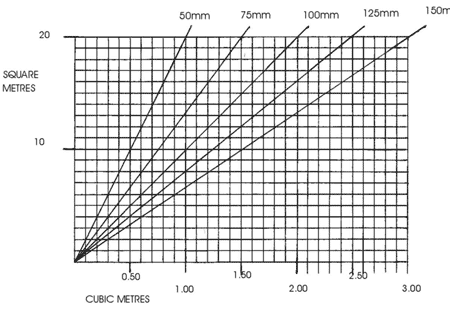
Graph showing the coverage of materials
An imperial standard brick is 9 inches long, 4 1/2 inches wide and 3 inches deep.
A metric brick is 8.86 inches long (225mm) 4.43 inches wide (112.5mm) and 2.95 inches deep (75mm).
The above sizes include mortar joints at 10mm
This makes the metric brick marginally smaller than its imperial counterpart and the difference, when joining new to old, must be taken up with an increase in the mortar joints.
There are 60 bricks to 1 square metre and you will use approximately 0.022 cubic metres of wet sand and cement to lay them with 10mm joints, this is equivalent to approximately 60kg.
A normal block is 2 bricks long, 3 bricks high and one brick wide (when laid with 10mm joints)
There are approx. 10 blocks to 1 square metre and you will use approx 0.012 cubic metres of wet sand and cement to lay them with a 10mm joint. This is equivalent to 31kg.
Paving slabs come in a variety of shapes and sizes, we have listed a few of the popular ones with their respective coverage
 |
 |
 |
| 225×450=10/sq.m | 450×450=5/sq.m | 600×600=2.75/sq.m |
 |
 |
|
| 450×520=5.75/sq.m | 450×520=3.7/sq.m |
Normally you will get 4 "drops" from one roll of paper with a standard close pattern. Some papers have patterns a long way apart, you will need to consult your supplier for this. The table below shows standard rolls with normal patterns.
| Measurement around room or length of wall in metres (including windows and doors) | ||||||||||||||||||
| Wall Heigh (from skirting updwards) | 2 (7′) | 4 (13′) | 6 (20′) | 8 (26′) | 10 (33′) | 12 (39′) | 13 (43′) | 14 (46′) | 15 (49′) | 16 (52′ | 17 (56′) | 18 (59′) | 19 (62′) | |||||
| 2 – 2.2m | 1 | 3 | 3 | 4 | 5 | 5 | 6 | 6 | 7 | 7 | 7 | 8 | 8 | |||||
| 2,2 – 2.4m | 1 | 2 | 3 | 4 | 5 | 6 | 6 | 7 | 7 | 8 | 8 | 9 | 9 | |||||
| 2.4 – 2.6m | 1 | 2 | 3 | 4 | 5 | 6 | 7 | 7 | 8 | 8 | 9 | 9 | 10 | |||||
| 2.6 – 2.8 m | 2 | 3 | 3 | 5 | 6 | 7 | 7 | 8 | 8 | 9 | 9 | 10 | 11 | |||||
| 2.8 – 3m | 2 | 3 | 3 | 5 | 6 | 7 | 8 | 8 | 9 | 9 | 10 | 11 | 11 | |||||
| 3 – 3.2m | 2 | 3 | 4 | 5 | 6 | 8 | 8 | 9 | 10 | 10 | 11 | 11 | 12 | |||||
| 3.2 – 3.4m | 2 | 3 | 4 | 6 | 7 | 8 | 9 | 9 | 10 | 11 | 11 | 12 | 13 | |||||
Thickness of glass, with the introduction of the metric system, is now defined in mm rather than weight. For the record here’s how it used to be.
| Glass Thickness | Glass Weight |
| 2mm | 18oz |
| 3mm | 24oz |
| 4mm | 32oz |
| 6mm | quarter inch plate |
All article content written and produced by Mike Edwards

 DIY Doctor Ltd,
  0845 6342 179


