
Air conditioning units, or HVAC systems, are common in offices, workplaces, and entertainment venues in the UK. While less common in homes, portable units that double as dehumidifiers are sometimes used.
Contrary to popular belief, modern air conditioners do more than cool air; they can also provide heat and other functions.
Though often associated with hotter climates like North and South America and the Middle East, air conditioning can be beneficial in the UK’s humid climate, improving working conditions.
The term “HVAC” stands for “Heating, Ventilation, and Air Conditioning”, covering the core functions of these systems.
What is Air Conditioning?
Air conditioning controls the filtration, air movement, temperature, and humidity of an environment. It’s primarily associated with cooling and dehumidifying air, often using refrigeration equipment.
Full air conditioning includes adding moisture with a humidifier, providing complete humidity control. However, most systems offer partial or comfort air conditioning, focusing on cooling and dehumidifying without humidifiers.
It’s important to note that ventilation is different from air conditioning. Refrigeration equipment used for air conditioning doesn’t necessarily include ventilation capabilities.
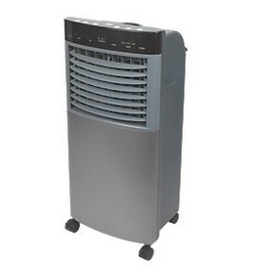
Common portable air conditioner
How Does an Air Conditioning System Work?
Air conditioning units function similarly to fridges and freezers but with a key difference: they cool the surrounding air instead of internal items.
They move warm air from inside to outside and circulate cooled air back into the space. Here’s how:
- The unit contains a compressor, cooling fins, a fan, and necessary pipework. The cooling fins have pipework with a special coolant fluid. Fans draw air across the fins and pipework, cooling the coolant.
- The compressor pumps the coolant to the evaporator via copper pipes, drastically cooling the evaporator’s pipes and fins.
- The fan system draws warm air from the room through the evaporator, cooling and dehumidifying the air by removing moisture.
- The cooled air is pumped back into the room, while the hot air and moisture are vented or drained away, depending on the system type.
Some systems have a thermostat. The process continues until the thermostat detects the desired temperature, then shuts the system off. When the temperature rises, the system activates and starts cooling again.
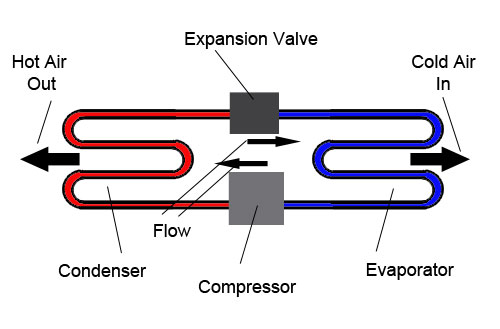
Basics of how an air conditioning system works
What is Relative Humidity?
Relative humidity refers to the amount of water vapor in the air relative to the maximum amount the air can hold at a given temperature. Warmer air can hold more moisture.
High temperature and humidity levels can be uncomfortable because the body struggles to cool itself through sweating. This is where air conditioners with humidity controls are beneficial, as they reduce moisture levels while cooling the air.
Relative humidity is the ratio of the current moisture level to the maximum moisture level the air can hold at the same temperature (100% relative humidity).
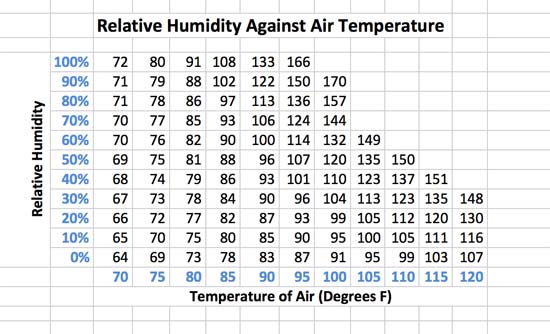
Chart showing relative humidity against air temperature
Differences Between Domestic and Industrial Air Conditioning
Domestic and industrial air conditioning systems differ mainly in their requirements. Domestic systems aim to create a comfortable environment for residents, typically maintaining humidity levels between 20% and 55%. In summer, a typical comfort setting might be 22°C with 50% humidity. Winter months usually don’t require humidity control.
Industrial air conditioning, however, focuses on creating a controlled environment for either employee comfort or specific industrial processes. For workplaces, temperatures between 20°C and 26°C with around 50% humidity are common. However, due to varying needs across different industries, ideal conditions can vary greatly.
Many workplaces now survey employees to determine ideal temperature and humidity levels, though preferences can vary widely.
What is Meant by a "Ton" of Refrigeration?
A ton of refrigeration measures the cooling effectiveness of a refrigeration or air conditioning unit, not its weight.
This term refers to the heat absorbed by one ton of ice as it melts from solid to liquid at 32°F. This process absorbs about 288,000 BTUs over 24 hours, or 12,000 BTUs per hour.
For example, an appliance with a 10-ton capacity produces 120,000 BTUs per hour.
BTUs are commonly used in Canada, North America, and parts of Asia. In contrast, European countries often use Watts to measure cooling capacity. Here’s a quick conversion:
- 1 Ton = 3.5 kW (approx)
- 1 kW = 0.28 Tons (approx)
If you need to convert kW’s to Ton’s or vice-versa then a handy converter can be found here.
BTUs: Measuring Air Conditioning Power
BTU stands for British Thermal Unit, a measure of heat flow used to determine the heating power needed for radiators and the cooling power required for air conditioning systems.
One BTU is the amount of heat needed to raise the temperature of one pound of water by one degree Fahrenheit at a constant pressure, specifically from 60°F to 61°F.
Estimating the cooling power of an air conditioning system involves several factors:
- Size of the room or area to be cooled
- Heat-producing objects in the room (e.g., people, computers, servers)
- Location of the air conditioning unit (e.g., shaded or in direct sunlight)
- Number and orientation of windows (e.g., south-facing windows get more sunlight)
- Whether the area is in the centre of the building or on an edge exposed to sunlight
These factors influence how effectively an air conditioning system operates, making it challenging to provide exact guidelines. However, the following “rules of thumb” can help:
- A large space (35-40 square meters) needs at least 15,000 BTUs
- A medium area (25-30 square meters) needs at least 10,000 BTUs
- A small space (15-20 square meters) needs at least 7,000 BTUs
What is Direct Expansion Equipment?
Direct Expansion (DX) equipment refers to refrigeration units and some air conditioning systems that use a refrigerant to cool air through compression or expansion. This term applies to both split and packaged air conditioning systems.
In a DX system, the refrigerant passes through an expansion valve that reduces its pressure and temperature before it enters the evaporator. Here, the refrigerant absorbs heat as it expands. The heated refrigerant then moves to the compressor, where it is compressed and condensed in the condenser, releasing heat.
The condensed refrigerant returns to a thermal expansion controller, regulating its pressure and flow back to the evaporator.
DX systems come in two types:
- Split Systems: The main components like the compressor and condenser are located outside, while ducting, fans, and the evaporator are inside. These components are connected by pipework that circulates the refrigerant.
- Packaged Systems: All components are housed in a single unit.
The efficiency of an air conditioning system depends on its size and the area it serves. Smaller systems serving large areas may face issues like humidity control, varying temperatures, and compressor problems under heavy load. One technique to address these issues is Hot Gas Bypass, which stabilises the evaporator coil temperature by mixing hot gases from the compressor output with those from the expansion valve output.
However, the suitability of Hot Gas Bypass depends on the specific system and its application.
Types of Air Conditioner System Setup
To cover all the various different installation and usage types, several different types of air conditioning system have been developed to best suit each usage situation. the main types are as follows:
Split Air Conditioning Systems
Split air conditioning systems consist of two components: one inside and one outside. This design offers several benefits, including a more appealing look compared to window units and a more compact size.
The outdoor unit typically houses the compressor and condenser, while the indoor unit contains the cooling fan and coil.
These systems are effective for cooling up to two rooms. They provide excellent cooling power and are the closest alternative to a full central air system.
Ductless split systems are relatively easy to install. Though some pipework is needed to connect the indoor and outdoor units, this can often be done with minimal disruption, especially if floorboards are accessible. These systems are also quiet since the noisy components are outside.
While split systems are aesthetically pleasing, provide great cooling, and are easy to install, they can be expensive.
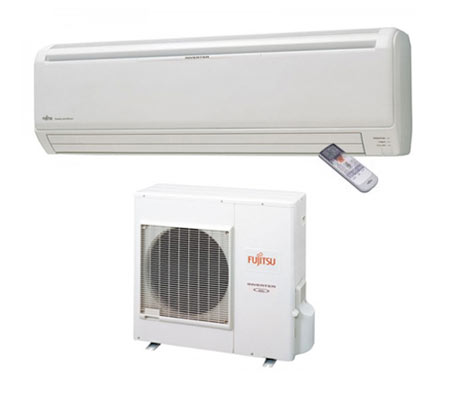
Split air conditioning system
Packaged Air Conditioning Systems
Packaged air conditioning systems are ideal for medium-sized spaces like larger homes, small entertainment venues, and restaurants. Unlike split systems, all components are housed in a single unit, similar to but larger than window units.
These systems use different cooling methods:
- Water-cooled condenser
- Air-cooled condenser
In water-cooled systems, a continuous water flow is needed to cool the condenser effectively. These units have the compressor at the base, the condenser and evaporator above it, followed by air handling components like the blower, air filter, and cooling coil. The size of the blower determines how many rooms it can cool.
Air-cooled systems house all core components in an outdoor unit that requires a constant airflow. A large fan draws air over the condensing coil to achieve cooling. The second unit, often called the cooling unit, contains the evaporator, filter, blower, and sometimes the expansion valve. Ducts carry the cooled air from the cooling unit to the rooms.
Air-cooled systems are more common because air is readily available, whereas a constant water flow can be harder to maintain.
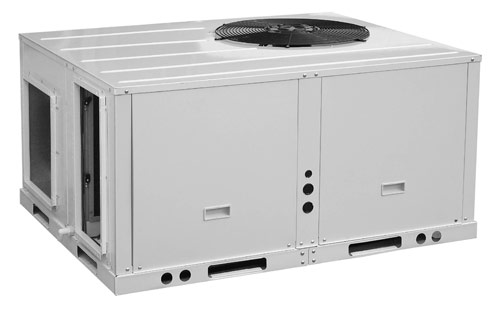
Packaged air conditioning system
Types of Air Conditioning Units and Systems
In terms of the different types of units, there are several options available depending on your requirements:
Window/Wall Air Conditioning Units
These units, commonly seen in American media, are among the most popular in the U.S. All components are housed in a single box, typically fitted in a window frame or on a wall. They vent warm air outside while cooling the interior.
If a window isn’t available, they can be wall-mounted. While they’re suitable for cooling a single room, they’re cost-effective and easy to install due to their self-contained design.
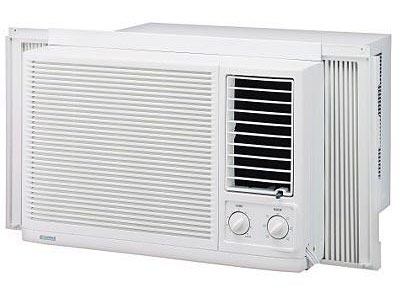
Window or wall mounted air conditioner
Central Air Conditioning Systems
These are high-end systems commonly used in large spaces like office buildings, shopping centres, and entertainment venues. They can also be adapted for home use.
These systems offer various functions including heating, air circulation, and humidity control. All key components like compressors, condensers, and fans are centrally located, typically in a plant room. Cooled air is distributed through ducts to desired areas, with separate ducting for air return.
Zone controls are often included, allowing different areas to be set at different temperatures for better control.
For heating, heat pumps or heat exchangers extract warmth from outside air and transfer it indoors. Backup heating ensures sufficient heat supply when needed.
Despite initial costs, these systems are economical and efficient, making them a smart choice for cooling large spaces in the long run.
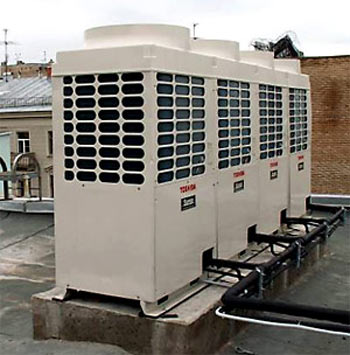
Large industrial central air conditioning system – Image courtesy of ahi-toshiba.com
Portable Air Conditioning Units
These units are more common in the UK compared to other options mentioned.
Portable and self-contained, they require no professional installation. Simply plug in and use.
There are two types:
- Single Hose Unit: Exhausts hot air from the room being cooled
- Dual Hose Unit: Exhausts hot air from the room and helps cool the unit itself
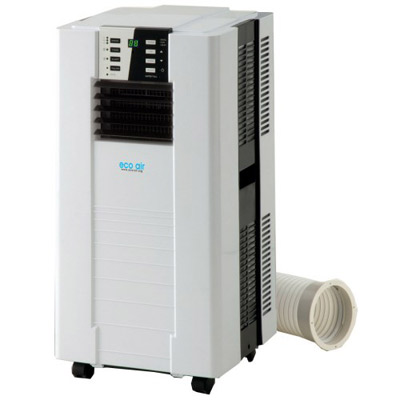
Single hose portable air conditioner
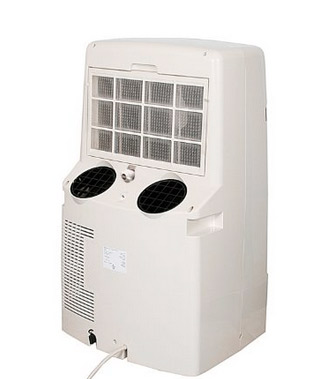
Twin hose portable air conditioner
While effective for small rooms, they’re inefficient for larger spaces.
Single hose units can cause air pressure drops, letting hot air in, making them work harder.
Despite limitations, they’re a cost-effective solution for cooling small spaces like bedrooms or home offices.
Modern units include built-in thermostats, digital displays, and dehumidifiers to manage moisture.
Regularly check and empty the water tank to avoid shutdowns due to full tanks.
Despite the UK’s reputation, a well-equipped system with heat supply and dehumidifier can be beneficial, especially in warmer months.
Although not common on a domestic basis in the UK, air conditioning systems do certainly have their place in many commercial properties throughout the country and although expensive, certainly domestically, if you do have the budget to afford a system then they’re certainly worth considering.

 DIY Doctor Ltd,
  0845 6342 179


