
Bathroom and kitchen waste traps or u bends as they are known remain a mystery to some people but the principle of the trap, be it a P trap, U bend, Gully trap, S trap, bottle trap, pedestal trap, shower or bath trap is exactly the same, they all work in pretty much the same way.
How do Waste Traps Work?
A waste trap uses a water barrier to stop the foul smelling gas and odour from a foul drain from entering a room.
On every appliance in the home that uses water and then has to drain it away, it must have a waste trap installed. This trap provides a seal between the drain that the waste pipe empties into and the inside of the room, stopping any foul smells from entering.
All waste gives off gas and odour and when you flush the toilet or drain the sink or bath, the water disappears out of your house to connect somewhere outside with the main drainage. The drainage which deals with everything except rain water is called foul drainage, and every foul drain pipe ends up in a foul water man hole or inspection chamber.
As you might imagine a great deal of toilet and bathroom waste leads to a great build up of foul gas and stench and due to the very nature of gas it tries to escape back up the pipes or through any other aperture it can get through.
If it manages to get back up a pipe it could, were it not prevented, get back into the room from where it came. Enter waste the trap!
A trap, of any kind is utterly useless on its own, its not until it has water in it that it becomes useful. How these specific types of trap work is that water sits in the base of the U bend where it forms a blockage and stops gas and any foul odours getting back into a room.
The water will sit just below the level of the outlet bend (seen in the image below) where it stays until more water is introduced from the appliance drain pipe. The incoming water will replace the water in the trap and push it out of the outlet. This principle works on all traps of this nature regardless of what type they are.
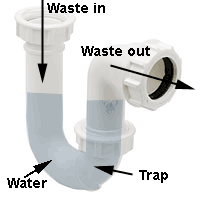
P Trap containing water and indicating incoming and outgoing water
What Types of Waste Trap are There?
In its simplest form, the waste trap is just a U-shaped piece of pipe with an inlet and an outlet and this is how the waste trap appeared for many years after its inception, however over the years the design has been refined to suit more specific situations. The most common of these types are as follows:
Bottle or Pedestal Waste Trap
With the bottle or pedestal waste trap the actual trap element in the equation is not obvious as unlike the traditional U or S bend the trap itself (as you may guess from the name) is shaped a bit like a bottle.
Despite the fact they don’t look alike, inside the work is done in exactly the same way. Water coming from the sink drain replaces the water in the bend, which is forced out. Any heavy deposits sink to the bottom of the trap and remain there, where as the lighter water can easily drain away. This can be seen in the diagram below.
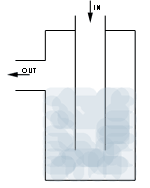
Inside of a bottle waste trap
Different traps are produced for different situations and in the case of a bottle trap they are long and thin and do not take up anywhere near as much room as their S and U shaped counterparts which makes them ideal to fit under a kitchen sink or bathroom basin.
Bottle waste traps are usually made of plastic but chrome plated versions are available for most applications. This type of trap can be hidden behind a pedestal although proprietary pedestal traps are a little longer.
To accommodate for all potential situations, bottle traps are available in both 32mm and 40mm sizes.
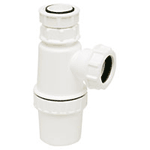
Bottle or pedestal waste trap
S-Bend, U-Bend and P-trap Waste Traps
The U bend waste trap was originally developed around the 1880’s by Thomas Crapper as a method of creating a seal between inner room spaces and foul smelling drains. As we have discussed above it works through using a water barrier to prevent smells from escaping drainage pipes
The U bend itself was a refinement of the original S bend design invented by Alex Cumming. The slight redesign improved on the original and also made it more compact and space saving.
The U bend in it’s original form first really appeared on the modern flushing toilet, again as a way of keeping foul smells at bay.
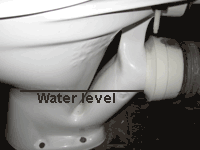
Toilet U bend indicating water level that prevents foul smell
Today both the S bend and U bend are still in use and are commonly found under kitchen sinks and on appliances such as washing machines and dishwashers.
As with the above S bends and U bends are available in both 32mm and 40mm diameters.
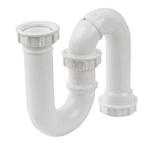
S bend waste trap
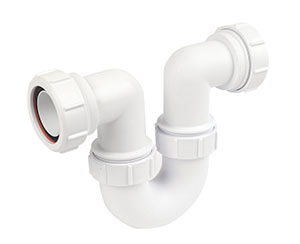
U bend waste trap
One further type of waste trap that falls under this category of the waste traps is the P-trap. The P-trap is essentially just a U-bend, only with some designs one side is slightly longer than the other and due to this when it’s turned on its side it looks a bit like a “P”.
In The US, U-bends are often referred to as P-traps but they are essentially the same thing and do exactly the same job.
Standard Shower Waste Trap
The standard shower waste trap works in very much the same way as the bottle trap. The actual water trap mechanism is contained inside the main body and again effectively creates a seal between the drain and the room space.
The main differences between the shower waste trap and the bottle trap are that, as space can be limited below a shower tray, shower wastes tend to be slightly more compact.
The other major difference is that in order to ensure the volumes of water that need draining from a shower can be drained quickly, the drain on a shower is a lot bigger than a sink drain, in most cases they are 90mm so to reflect this shower waste traps are also 90mm in size.
Additionally, most domestic sinks use 32mm pipework to form the drainage where as to provide increased flow, some shower wastes use 40mm pipework. When selecting shower wastes for a project ensure that you get the correct size.
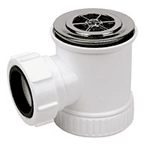
Shower waste trap
Shallow or Low Profile Waste Trap
In some extreme cases, especially in loft conversions and the like you have very little room between the underside of the shower tray and the floor or ceiling below. In these instances the low profile waste trap is your saviour!
Shallow traps are made to fit under the confined spaces found with baths and showers. In essence they do much the same job as other types of waste trap but they also usually include a removable top section to enable hairs etc. to be easily cleaned out.
As with the above they are generally available in 40mm to ensure the correct drainage flow and prevent water backing up and spilling out over the top of the shower tray.
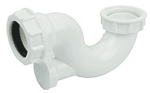
Shallow bath or shower waste trap
Gully Waste Trap
Although the gully trap doesn’t work exactly like a U bend in that it seals odour from escaping from a foul drain, it’s worth mentioning as it does share some similarities.
Unlike the U bend, the gully traps main purpose is to prevent mud and silt from entering the drainage system where it can easily cause blockages and other issues.
It does this by featuring a “sump” which is effectively a container. Three quarters or so up the side of the container is a drain pipe that connects to the main drainage. When water and mud flows into the gully, the mud and heavier waste sink to the base of the container and the lighter water that sits at the top flows away down the drain.
Gully traps are commonly used in outdoor areas and on driveways where surface water is drained from guttering and runoff into the main drainage and where other debris such as silt, leaves and the similar could easily get into the main drain causing untold issues.
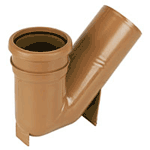
Gulley waste trap
Cleaning out a Waste Trap
Due to the very nature of the waste trap and the job it performs and also what generally gets disposed of down sinks and into appliance wastes, it’s inevitable that over time debris will collect and you will find that flow is restricted due to this and sometimes blockages can even form.
When this happens, to prevent any potential flooding you must empty the trap out and return the flow to its original state.
Emptying out a waste trap is an easy job and can be done by anyone by following these steps:
- Layout some old towels or clothes on the floor or underneath the trap that needs to be emptied. Ensure they cover the area fully
- Lay down a small container or bowl directly below the trap, on top of the towels or clothes
- If emptying a bottle trap, grip hold of the bottle part of the trap by the grip strip and turn it clockwise to unscrew it. Unscrew slowly and gently until it comes loose and empty the contents into the bowl/container
- If you’re emptying an S bend, grip hold of the middle screw connector and unscrew it gently. Once loose grip hold of the screw connector on the base of the sink drain and unscrew this. Hold it vertical and then empty the contents into the bowl/container
- In both situations, once the trap is apart and emptied out fully clean the inside of eth trap removing any and all gunk and sludge. With a bottle trap you will also have to fully clean the section still attached the basin
- Once cleaned out reassemble your trap using the reverse of how you took it apart
- Once back in one piece turn the sold tap on (if your working on a sink) and monitor the flow, all should now be back to normal.
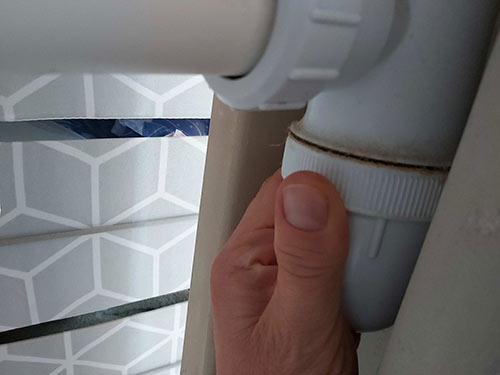
Unscrewing the bottle on a bottle trap
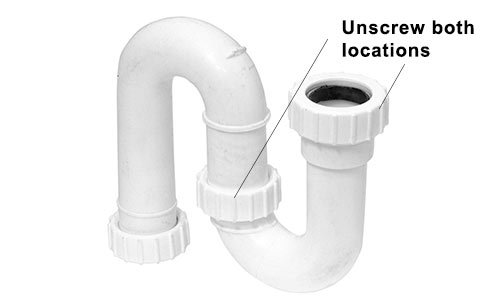
Unscrewing an S bend waste trap
It is possible to clean a U and S bend waste trap without taking it apart. To do this you can use a drain auger that you slide down through the pipework until you hit the blockage and then turn the handle which in turn, turn the brush or cleaning heads which clears the blockage.
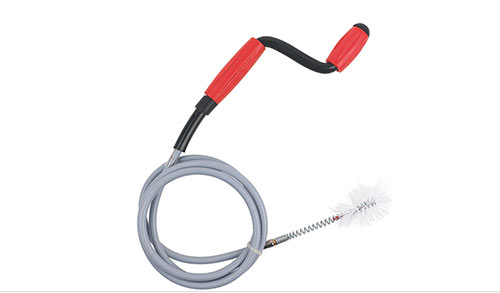
Drain auger for clearing blockages in drains
Considering how easy it is to take apart a waste trap it’s well worth just doing it properly as opposed to using an auger.
Do you Need a Waste Trap?
The short answer to this question is yes, you do have to have a waste trap on any appliance or fixture that empties water into a drainage system.
As we have stated, this is to prevent the foul smelling gasses that are emitted from sewage waste exiting through the drainage point and filling the room.
This rule is stipulated in Approved Document H of the Building Regulations in section 1.3 under Traps, it states the following:
1.3 All points of discharge into the system should be fitted with a trap (e.g. a water seal trap) to prevent foul air from the system entering the building. Under working and test conditions traps should retain a minimum seal of 25mm of water or equivalent.
Issues With Waste Traps
Sometimes, when removing a plug from the basin or bath, a gurgling sound can be heard coming from other pipework close by. This “gurgling” phenomenon is explained in our gurgling pipes project and the problem is easily overcome.
The noise is made because the speed with which the waste water is escaping forms a partial vacuum behind it which sucks water out from any nearby waste traps.
The normal fix for this, as explained in the above project is to provide ventilation in the system to equalise the air pressure.
However there are now anti vacuum waste traps available to make it even easier to resolve this problem.
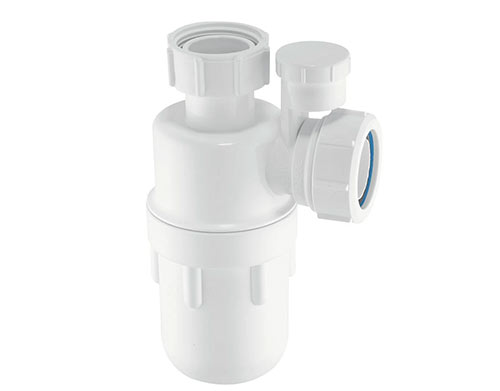
Anti vacuum waste trap used to eliminate gurgling in sinks and basins
The waste trap, regardless of the type you are using are absolutely essential and indeed a legal requirement for any appliances in the home that drain water into a main drain and without them you would the smell in your home would be almost unbearable.

 DIY Doctor Ltd,
  0845 6342 179


