
If you have ever suffered with noisy banging pipework when you run a tap or flush a toilet you will know how incredibly annoying this can be, especially when it happens in the dead of night. Fortunately there is a solution to this problem, read on to find out more.
What is Water Hammer and What Causes it?
The noisy pipe issue you are experiencing is commonly known as water hammer and it’s caused when high pressure water suddenly comes to an abrupt stop when a valve is shut off or suddenly changes direction. The pressurised water smashes into the pipe causing it to move and knock against walls, joists and any other items it’s surrounded by.
Many appliances tend to be particularly troublesome due to the fact water inlet control valves tend to be solenoid-powered and due to this can open and close in a fraction of a second, unlike a more traditional valve such as a tap that is closed a lot slower and therefore reduces the chances of water hammer occurring.
In some extreme situations, where the water is at very high pressure it can severely damage pipework and even cause the house to shake!
To expand a little more, the velocity of the water flowing through the valve means that when it is shut there is a sudden build up of pressure behind the valve, as more water tries to push on through the pipe. This increase in pressure causes a pressure wave to form which travels back down the pipe. The wave then travels up and down the pipe until the energy is dissipated through friction, this is why there is a ‘hammering’ effect.
If your pipes are not hammering but just making creaking noises, this is normally caused by the friction of the pipe moving on the joist or rafter. This can be easily resolved by getting some heavy duty polythene and fixing it between the two surfaces which reduces the friction.
Water Hammer in Systems With Header Tanks and Immersions
Although today many domestic water systems in modern homes simply utilise mains water and a combi-boiler so don’t necessarily feature header tanks (water storage tanks commonly in the loft) there are quite a few that still do, but unfortunately they can suffer with water hammer issues as much as any other system.
With these types of system, the entry of cold water into the tank is controlled by a "ball valve", as it also is with some toilets so they are subject to similar issues.
As hot water is drawn from the emersion tank, cold water rushes in from the cold tank to replace it. The same thing happens to your cistern when the toilet is flushed.
The incoming flow is regulated by a float, which rises with the water to shut off the valve when the tank is full. This float is generally in the form of a plastic ball on the end of an arm.
When the mains cold rushes into the tank/cistern it causes ripples on the surface and the float bobs about opening and closing the valve. It is this vibration within the valve and on the float arm which, when reverberating along the pipe, initiates the cause of water-hammer.
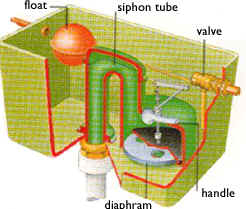
Components that make up a toilet cistern
How to Stop Water Hammer
Regardless of the type of water system you have in your home, all water hammer noise problems can be resolved in a fairly cheap and straight forward manner.
Securely Fix all Pipes
One of the main causes of water hammer is the fact that the pressure in the pipework causes it to move around and knock and bang against nearby objects and surfaces such as walls, joists, studwork and the similar.
One of the easiest and quickest fixes is to make sure that all of your pipework is securely clipped to walls or within studwork by using pipe clips. With this in mind, you should have a clip around ever 500mm or 2 clips per metre for both copper and plastic pipe.
However if you have particular problem pipe or set of pipes then it may be worth adding several more just to make sure the pipe doesn’t move at all.
Water Hammer Arrestor
The water hammer arrestor was a product developed to solve water hammer issues and there are quite a few different varieties out there from different manufacturers but they all tend to work in a similar way.
Essentially it’s a cylinder filled with air. As air compresses but water doesn’t, when there is a sudden rush of pressure, the air-filled cylinder absorbs the shock and prevents any water hammer form occurring.
Before fitting one you must first identify the particular appliance or run of pipework that is causing the issue. This is best done by simply creating the water hammer issue and then tracing the pipes that are creating the noise.
Once you know where they are you can then fit the arrestor.
When it comes to installation, this is in most cases just a simple matter of isolating the appliance, unscrewing the current connector, screwing on the arrestor and then screwing the supply pipe back on to it. Pretty much all will come with a standard screw fitting so should fit any existing plumbing fittings.
As water hammer can occur with both hot and cold supplies, ensure you fit an arrestor to both pipes.
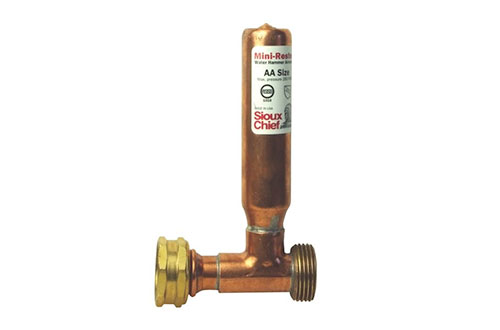
Water hammer arrestor
Mains Water Pressure Regulators
One other potential cause of water hammer issues is the fact that the mains water pressure coming into your home is far too high. In most UK homes the water pressure is somewhere around 30 – 60 psi (2 – 4 bar) and this is enough to ensure it reaches any taps or appliances.
However this can vary greatly and can range from 1 psi up to and over 4, but if it gets this high then due to the pressure this can cause water hammer in the same way as mentioned above, when valves are opened and closed rapidly or the flow changes direction sharply.
Fortunately this can also be remedied by fitting a pressure reducing valve to the incoming supply at the point that it enters your home e.g. at the mains stop cock.
Most valves of this type feature a screw or handle adjustment that can be turned to reduce the incoming pressure. Pretty much all valves will also feature a pressure gauge so you can see exactly what the pressure is at.
To fit them it’s simply a case of cutting the mains pipe after it enters your property, slotting each cut end into the valve, screwing up the compression nuts and olives to secure it in place and then making the required pressure adjustments.
High water pressure can also damage appliances and fixtures and fittings so by reducing it, you will also benefit from the fact that all your household goods should last much longer.
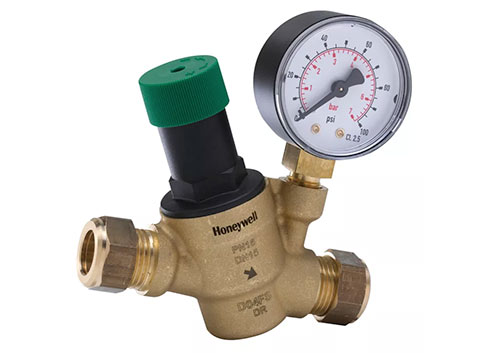
Mains water supply pressure reducing valve
Equilibrium and Noise Reduction Valves
If you have an old style high-level or low-level toilet and cistern and are also suffering from water hammer issues then the first and most effective way is to install a noise reduction valve or an equilibrium valve instead of the standard valve in your tank or cistern.
Most equilibrium valves today are built to reduce water hammer issues and they do this by allowing some water to get at the back of the piston washer to stop the arm jumping about, which in turn then causes the valve to open and shut rapidly and thus create water hammer.
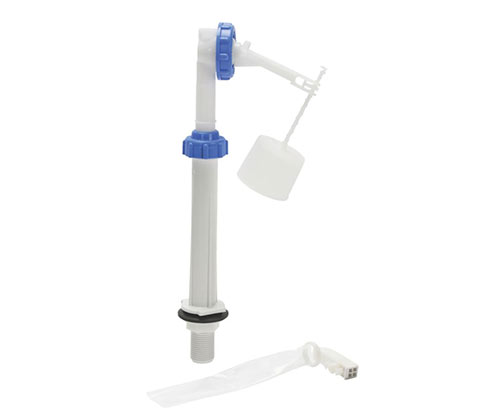
Modern Torbeck equilibrium valve
The noise reduction valve it is a further alternative, this allows incoming water to disperse below the water line and reduces the "waves", it slows the vibration down but most often will not stop it. The noise reduction valve does make a considerable difference to the noise your system makes when filling up.
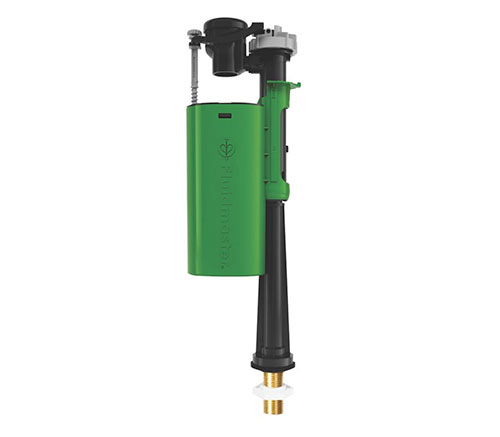
Modern noise reducing cistern fill valve
DIY Water Hammer Solution
Aside form the solutions mentioned above there is in fact a third solution albeit more of a cumbersome DIY bodge, but it can be very effective for a short while.
Take an ordinary yoghurt carton and attach it to your float arm with some galvanised or stainless steel wire, which will not rust. Suspend the carton just below the water line. When full of water it has enough weight to stop the vibration, but not too much to stop the arm lifting gently.
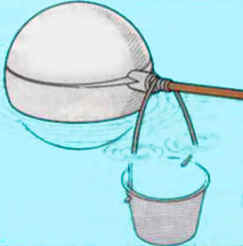
Yoghurt pot noise reducer
As annoying as water hammer noise is, in almost all cases it can be easily solved through the addition of certain specific products or by simply making sure your pipes are clipped up correctly.

 DIY Doctor Ltd,
  0845 6342 179


