
Warning: To complete electrical works you must comply with Electrical Regulations – Click here for more information.
Please also see our project on the New Wiring and Cable Colours.
This project has been updated to cover any changes made by the 17th edition of the wiring regulations (including earth bonding regulations). Please see notes below.
How Does Earth Bonding Work?
The earth, or ground in America, in electrical terms, carries no current, and it is this that electricity will make a dash for when it is allowed to escape from its secure home in an electric cable or flex. This is because one side of the electrical supply, the neutral, is intentionally connected to earth.
If someone touches a live conductor then a current will flow through the person, their shoes, the floor, the wall, via earth and back to the supply transformer via one or more earth connections of the transformer neutral. The person has completed the electrical circuit.
Should any fault develop in an electrical system the electricity will always head for earth, taking the easiest route there. The electrical appliances and supplies in the home are of a much higher potential and if any of these become available to touch and are electrically charged at a different voltage to the earth, the possibility of an electric shock exists when the current passes through the connection between the charged parts and earth.
If, for instance, a person comes into contact with a conductive part that is at a potential difference to earthed metalwork and that metalwork, then a very serious shock can result. In order to eliminate this possibility all electrical earths of circuits supplying equipment in the bathroom and all extraneous conductive parts are bonded together.
In this way, even if a potential does develop, such as during an earth fault on one of the electrical circuits, all the conductive parts that someone could touch will be at substantially the same voltage. No dangerous shock current can then flow.
On its way to earth, leaking current may pass through walls, floors or anything capable of carrying it. This is made much easier when the connecting substance is wet. Water is an excellent conductor of electricity which is why special care must be taken in the bathroom.
Regulations for Earth Bonding in your Bathroom
Bathrooms carry special rules as far as electricity is concerned. Water and electricity do not mix, so the utmost care has to be taken when electrical supplies run in or near the bathroom. To this end, in the 16th Edition of the IEE (Institution of Electrical Engineers) bathrooms carry their own very specific rules. We will deal with the use of earth bonding first and the rest later.
Should any electrical "leakages occur" in the bathroom the leaking current will try and find a passage to earth. It will travel down any damp in the walls or any metal or other conductors available. It is therefore important that precautions are taken to ensure these parts are not allowed to retain this current and diffuse it.
Available from Amazon

Available from Amazon
Connecting Earthing Straps
Earth bonding in the bathroom is done by connecting all of the metal parts together with an earth cable. This will collect the current or voltage from the leak and equalise it around the pipes and metal parts. Each metal part in the bath or shower room must be connected. We suggest the use of a specific 4mm earth cable for these connections. This is a minimum requirement without conduit and larger earth cable can be used. Please see new regulation notes below:
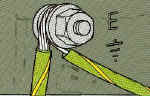
Earth bonding bracket
The earth tags (above) should be connected to all pipes and can be bought from most diy stores and electrical merchants. They are proprietary connections reading "ELECTRICAL CONNECTION DO NOT REMOVE".
The earth wire, after all bonding is complete should be connected to a local earth which could be a close socket immersion heater or the connection unit for a heater or shower. This is in accordance with BS7671 which reads:
All electrical earths of circuits that supply equipment in the bathroom should be connected to the equipotential bonding, not just one local earth.
The cable should not be taken back to the main fuseboard or consumer unit as this can be dangerous. Please see new regulation notes below.
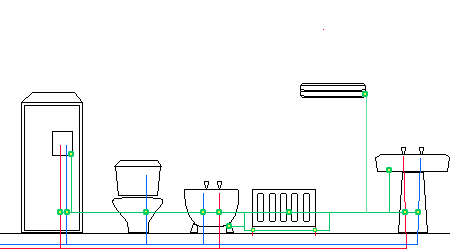
Cross section of earth bonding in the bathroom
The above layout shows a typical bathroom and its cross bonding layout.
- Red = hot water supply
- Blue = cold water supply
- Green = earth bonding cable
Plastic pipes and casings do not need to be bonded. The earth bond required to metal parts of a bathroom heater and shower can be very unsightly if taken to their next connection in the line, and it is permissible to connect the earth wires from these directly to the earthed electrical connection from which they are wired. Please note that if a bath is used for medical treatment or disabled people special considerations may apply and expert help should be sought.
Under IEE regulations the bathroom is now divided into zones for electrical purposes. The zone qualifications are quite complicated and professional guidance should be sought for any proposed electrical work in the bathroom. The basic rule is that no source of electrical supply should be accessible from a position where one can be in contact with water at the same time. Insulated operating cords of pull switches are permissible but they must be in accordance with BS 3676, which in most cases will be stamped or labeled on them.
Information can be found at the institute of electrical engineers website. Please also see new regulation notes below.
Wiring regulations and notes for earth bonding and earthing plastic pipework. You may also need to look at the regulations governing the height of electrical sockets if you are installing new sockets
Earth Bonding in Bathrooms and Shower Rooms
Until 2nd July 2008 The 16th edition of the wiring regulations applied as well as the 17th edition. From that date all installations must comply with the 17th edition only. The new requirement is for all electrical equipment in bath and shower rooms to be bonded together along with all metal pipework. Supplementary bonding connects to the earth wiring of the electrical equipment inside the bath or shower room. It must not be taken back to the main earth terminal in the consumer unit.
Section 701 in the 17th Edition deals with rooms that have a bath or a shower installed.
Supplementary equipotential bonding (between waste pipes, metallic service pipes and earth connections of bathroom equipment) is no longer required if, and only if, the main bonding between metal service pipes can be proved to be continuous. If so, the need for bonding (yellow and green) cable is unlikely to be necessary.
Zone 3 has also been removed from the 17th edition.
You are now allowed sockets in a bathroom if they can be placed at least 3 metres from the boundary of zone 1. Any such socket however, would need to be a spur socket or the end of a radial circuit as any circuit entering a bath or shower room must terminate there. Also please note:
- All circuits now need 30mA RCD protection.
- Cables in walls of bath or shower rooms have to be protected by a 30mA RCD.
- Shaver socket outlets are permitted as long as they are 3m from zone 1.
If you are in any doubt about the safety and legality of your project, please contact a qualified electrician.

 DIY Doctor Ltd,
  0845 6342 179


